

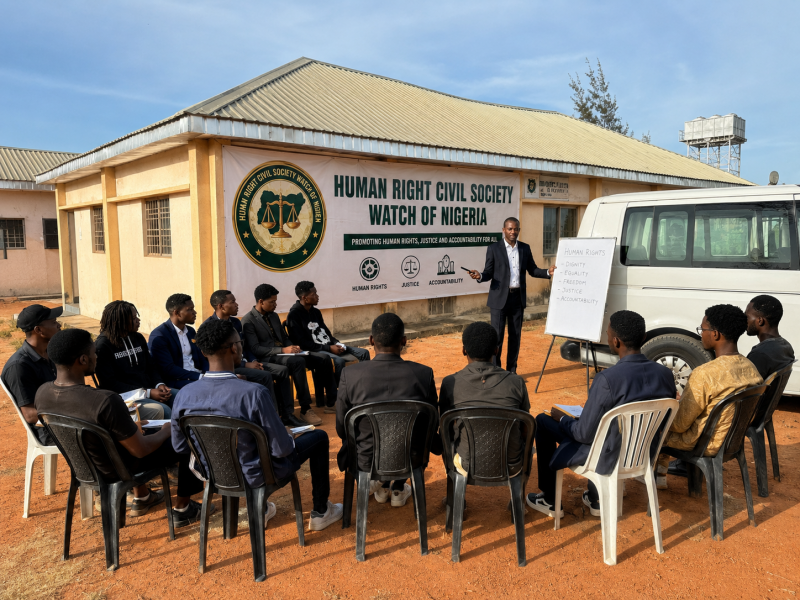
The Human Right Civil Society Watch of Nigeria (HRCSWN) traces its roots to 2011, when three visionary university students came together with a shared commitment to justice, human rights, and community empowerment.
The movement was founded by three young leaders from different academic backgrounds: a Law student who conceived the original idea, a Banking and Finance student who helped shape its organizational structure, and a Public Administration student who contributed to its leadership and community engagement strategy. United by a common purpose, they began discussing how ordinary citizens could work together to challenge oppression, confront social injustice, and defend the rights of vulnerable people within their communities.
At the time, concerns over abuse of power, police harassment, unlawful treatment of citizens, and widespread social inequality inspired the founders to establish a platform dedicated to advocacy, civic education, and the promotion of human rights. Their vision was simple but powerful: to create a movement that would empower citizens to understand their rights and stand against injustice through knowledge, organization, and lawful advocacy.
What began as a small student-led initiative quickly attracted members, primarily from the University of Benin, as well as community residents who shared the same passion for justice and social change. Members became known as "Leftists," not in a partisan political sense, but as individuals committed to social responsibility, civic consciousness, equality, and the protection of human dignity.
From its earliest days, the movement adopted a unique philosophy. Rather than pursuing national recognition immediately, members believed that meaningful change begins at the grassroots level. Their conviction was that transforming local communities through education, advocacy, and collective action would ultimately create a foundation for wider national impact. This community-first approach became a defining principle of the movement and remains central to its identity today.
As membership expanded, the organization developed a structured community network built around study and discussion groups known as Cells. Each Cell consisted of approximately ten members who met regularly to study civic issues, discuss social challenges, and deepen their understanding of the Constitution of the Federal Republic of Nigeria and other matters relating to human rights and governance.
Every Cell was led by a Cell Leader, commonly referred to as the Chief Leftist. Chief Leftists were expected to possess a strong understanding of constitutional principles, demonstrate integrity, and serve as role models within their communities. Through this system, members were encouraged not only to advocate for justice but also to continuously educate themselves and improve their ability to engage constructively in public discourse.
Over time, the movement's organizational structure evolved. State Chapters were established and coordinated by State Coordinators, while national activities came under the leadership of a National Coordinator. Community Cells and State Chapters continue to meet physically within their respective locations across the country, while the National Leadership conducts regular virtual meetings, bringing together representatives from various chapters. During national conventions and major gatherings, members meet physically to review progress, exchange ideas, and strengthen the bonds that unite the movement.
As the movement grew and sought formal recognition, its leaders pursued legal registration. However, due to regulatory constraints, the proposed name "Human Right Civil Society of Nigeria" was not approved by the Corporate Affairs Commission (CAC). This challenge led to the registration of the organization under the name Stain Stone Advocacy & Development Initiative.
Today, Human Right Civil Society Watch of Nigeria (HRCSWN) operates as the flagship activism movement and advocacy platform under Stain Stone Advocacy & Development Initiative. Through this structure, the movement continues its mission of defending human rights, promoting social justice, advancing civic participation, and strengthening democratic values across communities.
The movement's philosophy remains rooted in learning, critical thinking, and constructive engagement. Members are encouraged to continuously study, expand their knowledge, and improve their ability to advocate effectively for justice and positive social change.
This enduring commitment is reflected in the movement's guiding principle:
"Study, Know, and Improve Your Argument."
And in its enduring slogan:
"Don't Raise Your Voice; Improve Your Argument."
More than a decade after its founding, Human Right Civil Society Watch of Nigeria continues to stand as a community-driven movement dedicated to defending rights, promoting justice, empowering citizens, and building a more equitable society for all.
Add comment
Comments